
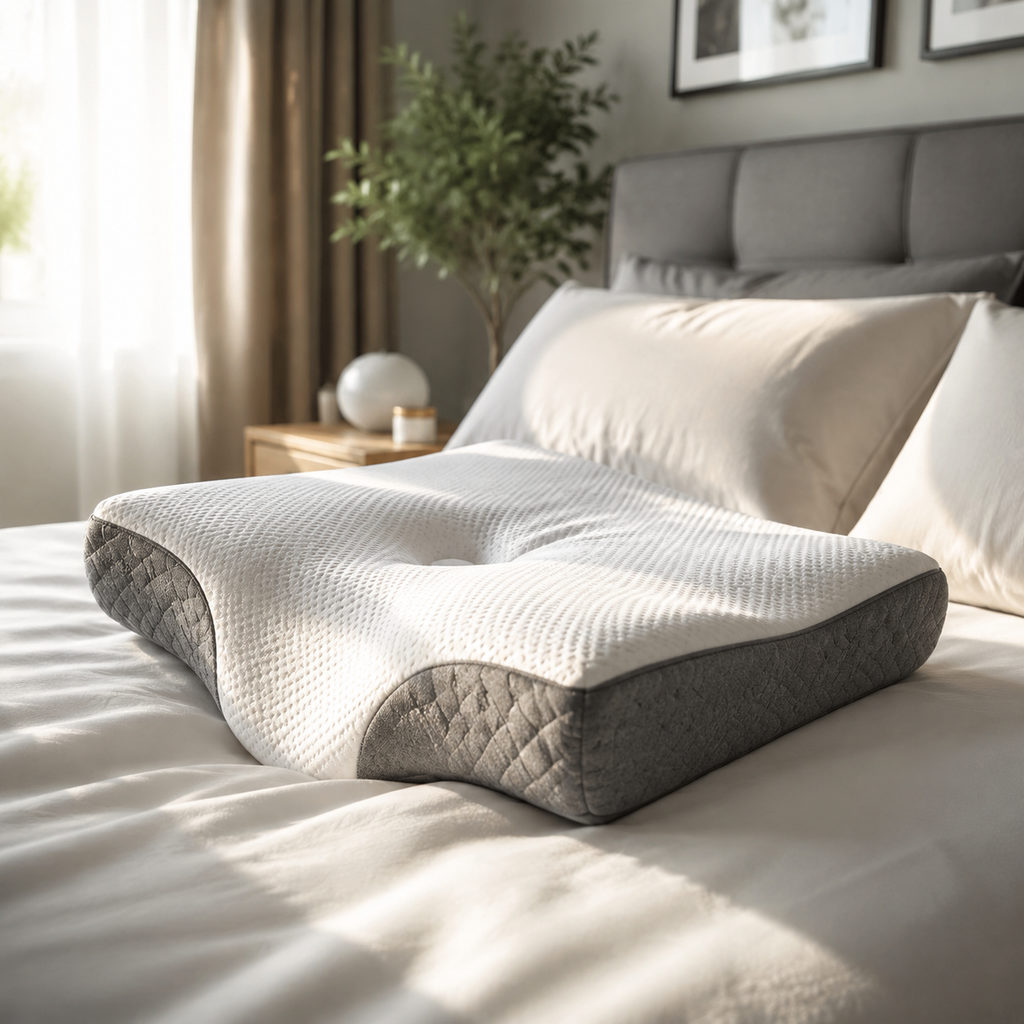
Finding the right pillow for sleep apnea isn’t about a miracle cure. It’s about position. A contour or a wedge changes the angle your head and torso sit at, and that can make it easier to settle off your back and stay there. We researched five popular options for home comfort, from cervical memory foam to a classic bed wedge. None of these replace a CPAP or a doctor’s visit. They’re comfort tools, nothing more.
Here’s how we sorted them. We looked at shape, support, sleep position, and how well each holds up night after night. Below you’ll find our top pick first, then four alternatives for side sleepers, hot sleepers, and folks dealing with acid reflux. Pick the one that matches how you actually sleep, not how you wish you slept.

Pros
- Dual-height design covers side, back, and stomach sleepers in a single pillow
- Firm slow-rebound foam holds its shape for orthopedic-grade neck support
- Cooling ice silk cover helps with night sweats and warm bedrooms
- Washable cover removes through a hidden zipper for simple upkeep
Cons
- Ships vacuum compressed, so it needs 24 to 48 hours to fully expand before it performs as intended
- New memory foam has a noticeable initial odor that takes some airing out
- Firm contoured foam is an adjustment if you're used to a soft, flat pillow
- Sold under a generic brand with no established reputation behind it
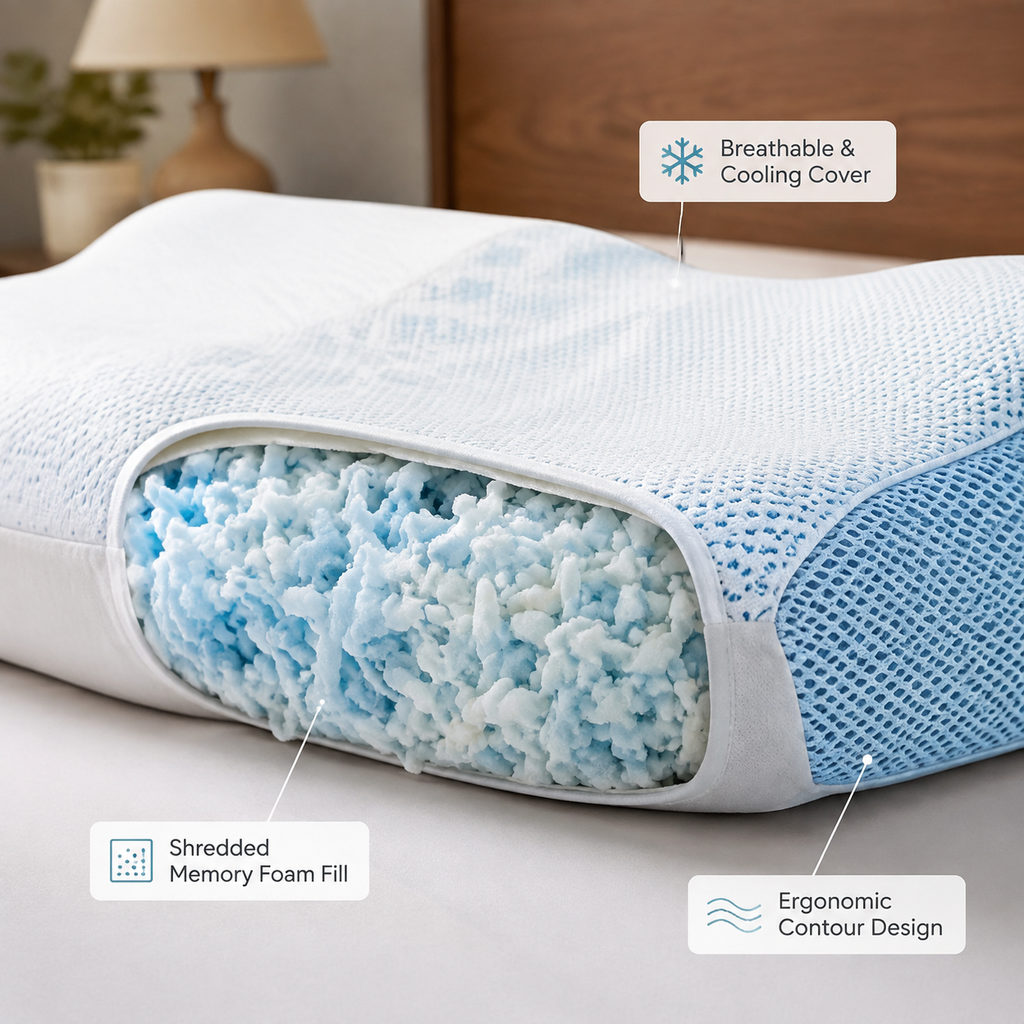
This is a contoured memory foam cervical pillow with two loft heights, so you can flip it lower for back sleeping or higher to fill the shoulder gap as a side sleeper. The standout is the removable ice silk cover with a nine-hole breathable structure that pulls heat away instead of trapping it.
It's a solid pick if neck pain or snoring wakes you up. Just know it ships compressed, so you'll need 24 to 48 hours for it to fully expand and air out.

Derila Ergo Cervical Memory Foam Pillow, Contoured Neck Support for Side & Back Sleepers, Cooling Cover, 21.25"
Pros
- Cooling cover prevents nighttime overheating
- Cervical contour supports proper spinal alignment
- CertiPUR-US certified for safety and durability
- Butterfly shape helps reduce snoring
Cons
- Zero verified customer reviews yet, so real-world performance isn't confirmed
- Fixed contour height may not suit all sleep positions equally
The Derila Ergo is a contoured cervical pillow built with high-density memory foam that adapts to your neck's natural curve. Its butterfly shape elevates your head to keep airways clear, which can help reduce snoring. Standout feature: the included cooling cover regulates temperature all night, so you won't wake up sweaty.
It's a smart pick if you're a side or back sleeper who struggles with overheating or shares a bed with a noisy partner. Keep in mind there aren't any verified reviews yet, so you'll be an early adopter. The certifications give confidence it's made without harsh chemicals.

Pros
- Dual-height flip design covers both side and back sleeping positions in one pillow
- Genuine cooling construction with ice silk cover and mesh sides, not just a marketing claim
- Dual certification (CertiPUR-US, OEKO-TEX) on the foam and cover
- 100-night trial removes most of the risk of trying a contour shape
Cons
- Contoured cervical shapes take roughly a week or two to adjust to, and stomach sleepers generally can't use them at all
- Slow-rebound high-density foam feels firm; if you prefer a plush pillow, this isn't it
- Very little customer feedback available yet, so long-term durability is unproven
- 6-month warranty is short compared to the multi-year coverage some memory foam pillow brands offer
The ZeroZillo is a contoured memory foam cervical pillow built to hold your neck in its natural curve overnight. Its best trick is the flip: a taller contour for side sleepers, a lower one for back sleepers. Cooling is handled properly too, with an ice silk cover over 3D mesh side panels.
Good pick if you wake up stiff and sleep hot. Not for stomach sleepers, and the slow-rebound foam is firm, so you'll need a week or two before it feels normal. The 100-night trial covers that adjustment.

Pros
- Innovative hollow design accommodates multiple sleeping positions without compromising neck alignment
- Genuine cooling technology with measurable temperature reduction, not just marketing claims
- Height customization through rotation and removable inserts adapts to individual needs
- Breathable construction prevents heat buildup common with standard memory foam
- Six-zone contouring addresses specific pressure points for comprehensive support
Cons
- Memory foam requires 48-hour airing before use to dissipate initial odor
- Adjustment period needed as body adapts to contoured support
- Manual measurement variations mean actual size may differ slightly from listed dimensions
An ergonomic contour with a low head channel, a raised neck ridge, and taller wings that fill the gap between jaw and mattress on your side. Your head lands in one spot and stays.
Off-gassing is genuinely mild for foam. It runs firm, the wings press on the ear, and if you roll onto your back you'll fight the shape.
- Dimensions: 23.2 × 13.4 × 5.1 inches
- Core Material: 98% breathable memory foam
- Pillowcase: Q-Max 0.4 Arc-Chill cooling fabric with 3D mesh
- Temperature Reduction: Up to 5°C instant cooling
- Neck Angle: 15-degree ergonomic tilt
- Support Zones: Six contoured areas
- Height: Adjustable via rotation or removable insert
- Sleep Positions: Side, back, and stomach compatible
- Trial Period: 100 nights risk-free

Pros
- Two-layer construction balances softness and support better than a single-density foam wedge
- Wide 24-inch surface keeps shoulders and back aligned instead of bending you at the neck
- Jacquard cover looks like bedding, not medical equipment, and comes off for washing
- FSA eligibility offsets the cost for anyone with a health spending account
- Available in a taller 12-inch version if you later need more elevation
Cons
- At 7.5 inches, the incline may be too shallow for severe acid reflux or sleep apnea, where clinicians often recommend steeper elevation
- Fixed foam wedges can't be adjusted, so if the angle isn't right for you there's no dialing it in
- Memory foam wedges typically sleep warm, and there's no cooling gel or ventilated core mentioned here
- No product weight or firmness rating listed, so repositioning effort and feel are hard to gauge before it arrives
The Kolbs wedge hits a moderate 7.5-inch height that's friendly for reflux relief without a steep learning curve. The jacquard cover looks nicer than standard jersey fabric, and it's FSA eligible if you're spending health account dollars.
The foam runs firm and holds its angle reliably night after night. It's not as tall as the top pick, so severe reflux sufferers might want more incline. But for most folks, it's the right balance of elevation, price, and comfort.
- Dimensions: 24 x 24 x 7.5 inches (12-inch option measures 25 x 25 x 12)
- Top layer: 1.5 inch plush memory foam
- Core: High-density medical grade foam
- Cover: Removable, machine washable jacquard
- Brand: Kölbs, by K2 Health Products
- FSA eligible: Yes
- Category: Climate Pledge Friendly, Home & Kitchen
- Intended use: Chronic care positioning for respiratory, cardiovascular, circulatory, and mobility conditions
How We Picked
We didn’t rely on marketing claims. We compared contour height, foam density, cooling covers, and adjustability across each pillow, then weighed real owner feedback on snoring and morning neck comfort. Anything that flattened out fast or slept hot got marked down. We also weighed mask clearance, meaning whether the shape leaves room for a CPAP mask and hose or puts a raised edge right where the seal sits. And where a listing publishes no loft or density figure, we say so rather than guessing.
Comfort matters, but so does honesty. A pillow can’t treat sleep apnea on its own, and we say so plainly. What it can do is support your head and neck so your airway stays a bit more open. That’s the bar we held every pick to.
The 5 Best Pillows for Sleep Apnea
Ergo Cervical Pillow — Best Overall
The Ergo Cervical Pillow earns the top spot on geometry alone. Its contour has a defined dip for the head and a raised lip under the neck, and the foam runs firm enough that the shape doesn’t collapse into a flat slab by month two. That matters here. A pillow that flattens stops doing the one job you bought it for. Side sleepers get the most out of the raised edge, which gives you something to settle against instead of drifting onto your back at 3am. Two real drawbacks. The firmness needs a few nights before it stops feeling foreign, and the contoured sides sit close to the face, so anyone wearing a CPAP mask should check clearance before committing. The listing doesn’t quote a loft figure or a foam density, and it doesn’t claim mask compatibility either, so don’t assume it. It’s sold in one standard size and one gray colorway. Stomach sleepers, skip it entirely. For most back and side sleepers, though, this is the one we’d hand a friend first.
Derila Ergo Pillow — Best Contour
Derila’s butterfly shape is the most aggressive contour in this group. The wings rise at the sides and dip in the middle, so a side sleeper’s head sits in the channel while the shoulder tucks under the flare instead of getting crushed. The listing quotes 4.72 inches of height across a 21.25 by 14.17 inch footprint, and that’s a genuinely useful number to have, since three of the other picks publish nothing about loft. Read it against your own shoulder width. Broad shoulders will find under five inches shallow, and a shallow pillow tips the head down toward the mattress; petite sleepers usually land right. Firmness over months matters too, since a contour that softens stops holding you anywhere. The gripes are practical. The cover isn’t a cooling cover, so if you sleep warm you’ll be flipping it, and the footprint is narrow for a standard pillowcase, which makes changing covers fiddly. Nothing in the listing mentions CPAP mask clearance, and those raised wings sit where a mask strap does. Worth measuring first.
ZeroZillo Neck Pillow — Best Value
Nothing about the ZeroZillo is clever, and that’s the appeal. It’s a plain cervical contour at the budget end of this group, medium in support, with no cooling panel and no adjustable insert to fiddle with. First-timers do well on it precisely because there’s little to learn. The foam runs softer than the Ergo’s, though, and that’s where the trouble starts for a heavier head. Press through the contour and the shape stops holding you on your side, which is the whole reason to buy a contour in the first place. The cover is the other thing to think about. A mask and hose rest against a pillow every night, so you’ll be washing it more often than a plain bedroom pillow, and the listing says nothing about whether the cover comes off. It publishes no loft height and no foam density either, and makes no CPAP claim at all. Broad-shouldered side sleepers should look higher up this list. Fine as a first cervical pillow. Not the one to buy twice.
Cozyplayer Cooling Pillow — Best Cooling
Adjustability is the reason the Cozyplayer is here. The loft can be tuned, which is the most useful feature on this list for anyone matching pillow height to shoulder width, and it’s the only pick that lets you correct a bad guess after the box is open. Too much height cranes the neck; too little drops it. The listing also calls the foam odorless, which counts for something in this category, and it’s pitched at stomach sleepers as well as side and back, which the firm contours here aren’t. Support is where it gives ground. It sits softer than the Ergo or Derila, and a soft adjustable fill tends to drift back toward flat over months, so plan on topping it up. The cooling cover does real work in a cool room and much less in a warm one. Set expectations there. The listing quotes no loft range and no fill weight, so adjustable comes with no numbers attached, and there’s no mask-clearance claim either.
Kolbs Bed Wedge — Best Wedge
The Kolbs wedge isn’t competing with the other four. It doesn’t cradle a neck at all; it raises the whole upper body on a 7.5 inch incline, and that changes how you lie rather than how your head is propped. Practical upside for anyone on CPAP: a wedge leaves the head area clear, so a mask and hose have somewhere to go, and the hose can run down the slope instead of under your shoulder. The cover is jacquard and the wedge is FSA eligible, per the listing. Now the limits, and they’re real. A wedge holds you on your back or upright, which is the opposite of what a side sleeper wants, and it takes up a large slice of the bed, so a partner will notice. The firm foam keeps its angle, but sliding down it in the night is the standard complaint with any wedge. You’ll also want a thin pillow on top. Owner ratings sit lowest of the five, which fits a product that either suits your body or doesn’t.
| Model | Type | Best Position | Best For | Price Tier |
|---|---|---|---|---|
| Ergo Cervical Pillow | Contour memory foam | Back & side | All-around airway support | Premium |
| Derila Ergo Pillow | Butterfly contour foam | Side & back | Side-sleeper alignment | Mid-range |
| ZeroZillo Neck Pillow | Contour memory foam | Back & side | First-time cervical users | Budget |
| Cozyplayer Cooling Pillow | Adjustable cooling contour | Any (adjustable) | Hot sleepers | Mid-range |
| Kolbs Bed Wedge | Foam wedge | Back & upright | Acid reflux & elevation | Budget |
What to Look for in a Pillow for Sleep Apnea
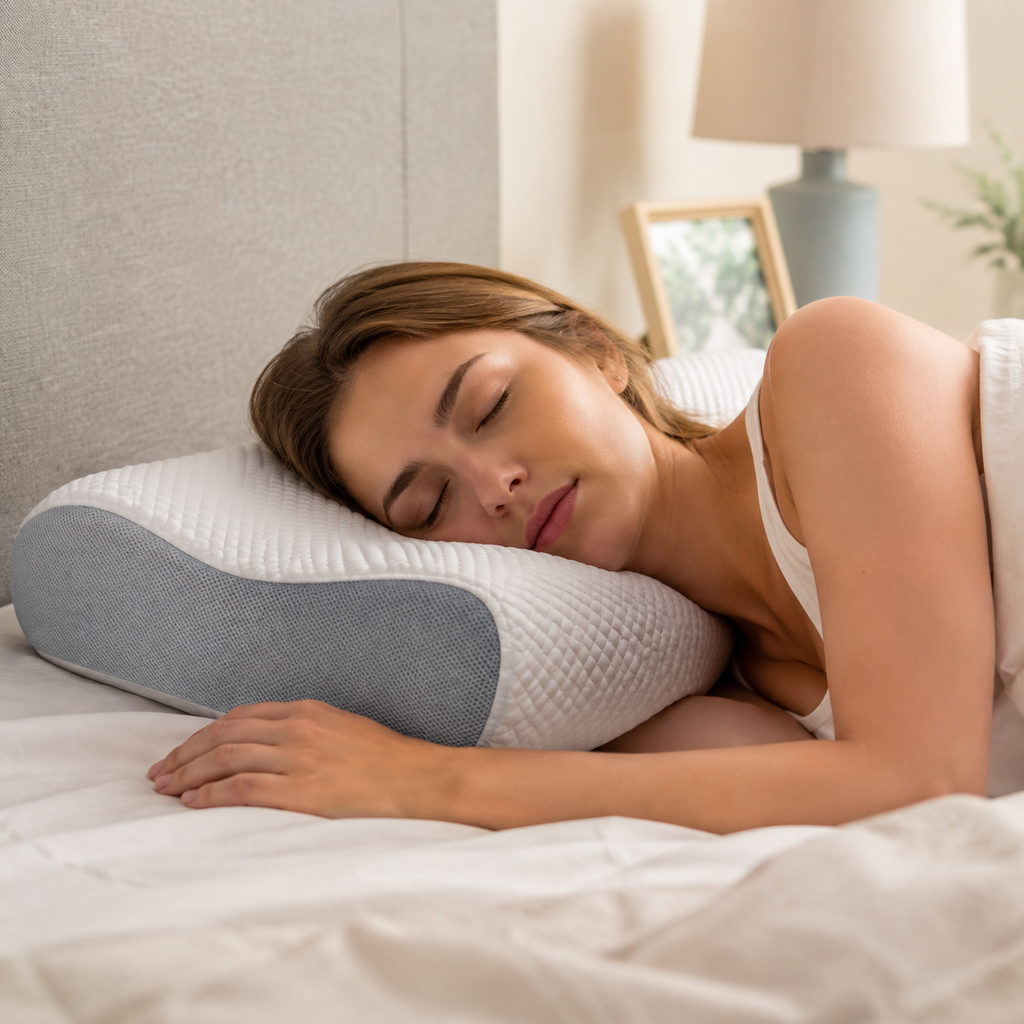
Match the shape to your sleep position. A pillow for sleep apnea only works if it keeps your head neutral instead of kinking your neck. Side sleepers need a taller contour with shoulder cutouts; back sleepers do fine with a moderate dip. Stomach sleepers usually struggle with any cervical pillow.
Prioritize airway-friendly positioning. The whole point is head and torso position. Contour pillows work by keeping the neck in line with the spine; wedges work by raising the upper body. Neither is a treatment, and none of these listings claims to be one. What a shape can do is make one sleeping position easier to hold all night.
Don’t ignore firmness and foam quality. Cheap foam flattens within weeks, dropping your head back into a bad angle. Medium-firm memory foam that springs back holds the position you paid for. If reviews mention sagging, walk away.
Consider heat, adjustability, and FSA perks. If you sleep hot, a cooling cover keeps you from flipping the pillow all night. Adjustable loft helps you dial in the exact height. And an FSA-eligible option, like a bed wedge, lets you spend pre-tax dollars on comfort.
Frequently Asked Questions
Can a pillow cure sleep apnea?
No. A pillow can’t cure or treat sleep apnea, and none of these listings claims otherwise. They’re comfort and positioning products: a shape can make it easier to settle off your back, or leave clearance for a CPAP mask and hose. If you suspect sleep apnea, see a doctor for a diagnosis and a treatment plan. A pillow is not a substitute for prescribed equipment.
Is a wedge or a contour pillow better for sleep apnea?
It depends on your sleep style. Contour pillows suit side and back sleepers who want neck alignment. A wedge suits people who also deal with acid reflux and don’t mind sleeping on an incline. Side sleepers generally do better with a contour.
Can you use a cervical pillow with a CPAP mask?
None of these five listings claims CPAP compatibility, so treat mask clearance as something to check rather than assume. What matters is whether the raised sides press against the mask frame or straps when you turn, since that’s what breaks a seal, and whether the hose can run off the edge instead of under your shoulder. The Kolbs wedge is the easiest of the group on that front, because the head area stays open. With a contour, measure your mask against the channel between the wings before you commit.
Will these pillows stop my snoring?
They might reduce it. By keeping your head neutral or your torso elevated, these pillows may help lessen the airway collapse that causes snoring. Results vary, and heavy snoring can signal apnea worth discussing with a doctor.
How long until a cervical pillow feels comfortable?
Give it a week or two. Contour pillows feel firm and oddly shaped at first because they’re holding your neck in a new position. Most people adjust within several nights. If it still hurts after two weeks, the loft’s probably wrong for you.
Related Guides
- best seat cushion for an office chair
- best mattress vacuum cleaner
- best ergonomic seat cushion
- More sleep & comfort guides
The Bottom Line
Choosing a pillow for sleep apnea comes down to how you sleep and what sits on your face at night. The Ergo Cervical Pillow is the one we’d point most back and side sleepers to, because its shape is firm enough to keep doing its job after a few months. Derila is the pick if you want a deeper channel and shoulder wings, and it’s the only one that publishes its height, so you can check it against your own shoulders before ordering. Cozyplayer earns the nod for warm rooms and for anyone who wants to adjust loft later. ZeroZillo is the low-cost way in. Kolbs is a different animal, an incline rather than a contour, and the easiest of the group to route a mask and hose around. None of these are medical equipment, and none replace what you’ve been prescribed. If your snoring or daytime fatigue is serious, book a sleep study and talk to a doctor first.

Leave a Reply