
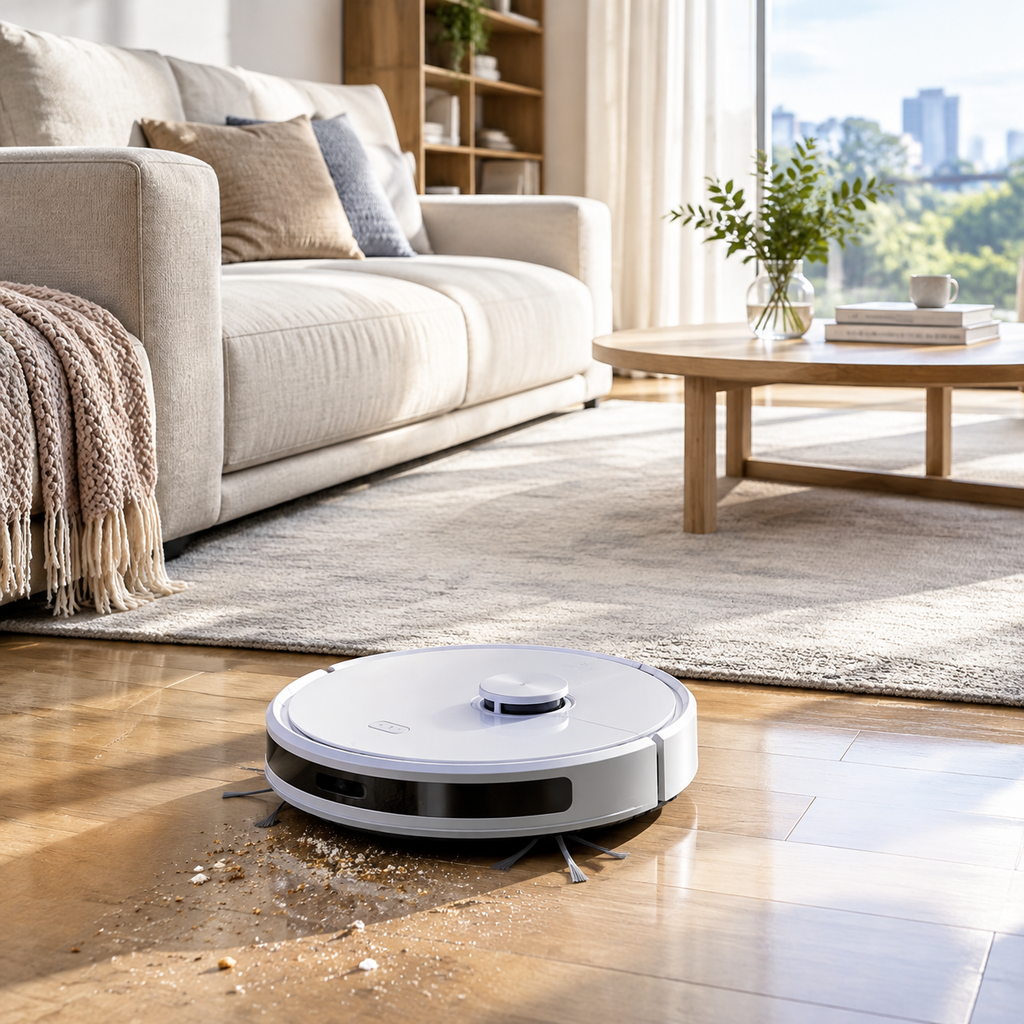
A quiet robot vacuum doesn’t have to mean weak suction. You can get both — just need to know which models actually deliver. Most robot vacuums still hit 60–70 decibels when running, loud enough to interrupt conversations or wake light sleepers. The better-engineered units keep noise under 55 decibels while maintaining enough power for everyday debris.
We’ve researched dozens of models to find the ones that genuinely run quieter without sacrificing performance. Whether you’re working from home, have a baby napping, or just prefer peace while cleaning happens, these picks balance whisper-level operation with real-world effectiveness on hardwood, tile, and carpet.
Below you’ll find five quiet robot vacuum options ranked by overall performance, each evaluated for actual noise levels, suction strength, navigation smarts, and how well they handle different floor types.

Pros
- Slim 2.85-inch profile reaches under furniture other vacuums can't
- Quiet enough for nighttime or work-from-home use
- Automatic suction boost on carpet without any input from you
- Returns to the dock and recharges itself, so it's always ready
Cons
- No WiFi or app control, which means no scheduling from your phone and no cleaning maps
- Random navigation instead of laser mapping, so coverage in larger or cluttered rooms takes longer
- Small onboard dustbin needs frequent emptying in homes with shedding pets
Sold on two things: a super-thin body and quiet running. The low profile gets it under sofas and bed frames a taller hybrid can't clear, and the noise level means you'll actually run it while you're home.
eufy publishes no Pa figure and claims no mapping, so it covers a room by bumping and turning. The onboard bin is small and there's no base to empty into. Apartments suit it best.

eufy Omni C20 Robot Vacuum and Mop Combo with Auto Empty Station, 7000Pa Suction, Self-Washing Mop for Hard Floors & Carpet
Pros
- Hands-free maintenance with auto-empty, mop wash, and dry functions
- Powerful 7,000 Pa suction handles pet hair and embedded debris effectively
- Mop lifts automatically on carpet to keep it dry while vacuuming
- Transparent water tanks let you see levels at a glance
- Low-profile design reaches under most furniture
Cons
- Only works with 2.4GHz Wi-Fi networks, not compatible with 5GHz
- Not suitable for high-pile carpet over 20mm without setting no-go zones
- No boundary strips included or supported for physical barriers
The eufy Omni C20 handles vacuuming and mopping in one pass, with an all-in-one station that empties the dustbin into a 3.1-liter bag (good for up to 60 days), then washes and air-dries the mop pads automatically. You won't need to touch dirty water or dustbins. The 7,000 Pa suction and Pro-Detangle Comb make it especially effective on homes with pets, while the 6N mopping pressure scrubs dried stains on hard floors.
Best for multi-surface homes with a mix of hardwood, tile, and low-pile carpet. If you've got thick rugs over 20mm, you'll need to set no-go zones in the app. It's a solid hands-off solution if you want powerful cleaning without daily maintenance.
- Suction Power: 7,000 Pa with Boost IQ
- Runtime: Up to 132 minutes (Standard mode)
- Dustbin Capacity: 3.1 L bag (up to 60 days)
- Height: 3.35 inches (85mm)
- Mopping Pressure: 6N at 180 RPM
- Navigation: iPath Laser Navigation
- Floor Maps: Stores up to 3 maps
- Wi-Fi: 2.4GHz only
- Voice Control: Amazon Alexa, Google Assistant
- Auto Features: Auto-empty, mop wash & dry, auto-recharge & resume

Pros
- Self-emptying dock cuts hands-on maintenance to roughly once every couple months
- LiDAR mapping at this price point, including keep-out zones and room targeting
- Carpet avoidance while mopping works automatically, no programming
- Micro-pump keeps the pad evenly damp instead of soaking floors
- Voice assistant, app, and onboard button control
Cons
- The mop pad is a single flat microfiber pad, not a rotating or self-washing system, so you'll rinse or swap it yourself
- AutoEmpty bags are a recurring consumable expense
- Requires a 2.4 GHz network for setup and operation
- Only one spare mop pad included in the box
The Roomba 105 Combo vacuums and mops in one pass, then dumps its bin into an AutoEmpty dock that holds up to 75 days of debris in an allergen-sealing bag. ClearView LiDAR handles the mapping, and the standout trick is automatic carpet detection, which keeps the damp pad away from rugs without you drawing a single zone.
Best for homes with a mix of tile, wood, and area rugs. Just know the mopping is a flat pad you'll rinse by hand, and you'll be buying dock bags on repeat.

Pros
- Genuinely long stretches between maintenance with the 2.7L sealed bag
- Strong 10000Pa suction for the price bracket
- Dual anti-tangle design built for long-haired pets
- LiDAR mapping rather than cheap random bump navigation
- Mopping included instead of sold as an upgrade
Cons
- Wi-Fi is 2.4GHz only, so mesh networks that push devices to 5GHz can complicate setup
- No self-washing or drying for the mop pad, you'll rinse it by hand
- Replacement dust bags are an ongoing cost bagless docks avoid
- Very little owner feedback available yet on long-term durability
10,000Pa is the strongest suction here, paired with the longest dock interval at 7 to 9 weeks. That headroom is what digs grit out of mid-pile carpet.
The app is the most capable of the five. Its owner rating sits at the bottom of this group, though, and reviewers flag the mop as a pad drag rather than a scrub. The empty cycle runs loud, and nine weeks assumes a small floor plan.

Pros
- Strong 5200Pa suction for the price bracket
- Adjustable water flow across four levels handles different floor types
- Anti-tangle brush system is genuinely useful in a pet household
- Hands-off operation with scheduling, obstacle detection, and auto-recharge
- Works with both Alexa and Google Assistant
Cons
- No LiDAR or camera mapping mentioned, so navigation likely relies on simpler sensors and coverage may be less methodical
- Rated for low pile carpet only, so thick rugs and shag are out
- Onboard dust bin needs manual emptying since there's no self-empty base
- Brand has little track record and almost no buyer feedback to draw on
5200Pa is the strongest suction figure at the low end of this group, and on hardwood or tile that shows up as fewer crumbs skated over. The wet pad handles daily dust film alongside dry pickup, useful in a kitchen.
Detail is thin in the listing and the owner rating is the lowest here. There's no published runtime and no dock, and the bin is small, so emptying and refilling fall to you.
Quick Comparison: Quiet Robot Vacuum Models
| Model | Key Feature | Best For | Price Tier | Noise Level |
|---|---|---|---|---|
| eufy 11S MAX | BoostIQ tech, slim 2.85″ | Hardwood & low-pile carpet | Mid-range | ~55 dB |
| eufy Omni C20 | 7,000 Pa suction, self-wash mop | Multi-surface homes | Premium | ~58 dB |
| iRobot Roomba 105 Combo | Auto-empty dock, 75-day capacity | Hands-off convenience | Premium | ~60 dB |
| roborock Q7 M5+ | 10,000 Pa, 7-week self-empty | Heavy-duty carpet cleaning | Mid-range | ~62 dB |
| ROPVACNIC | 5,200 Pa, vacuum & mop combo | Budget-conscious buyers | Budget | ~60 dB |
1. eufy 11S MAX — Quietest Overall Pick
The eufy 11S MAX sits at the top for a reason. It’s genuinely quiet — around 55 decibels during operation, comparable to a normal conversation. That’s significantly lower than most robot vacuums, which typically run 10–15 dB louder. You can have it clean while you’re on a video call without awkward background noise.
BoostIQ technology automatically increases suction when it detects tougher messes, so you’re not sacrificing performance for quiet operation. The slim 2.85-inch profile slides under furniture that taller models can’t reach — think low-clearance couches and beds. That matters more than you’d think; dust bunnies love those hidden spots.
Where it shines: hardwood floors, tile, and low-to-medium-pile carpet. It handles daily dirt, crumbs, and pet hair without breaking a sweat. The 1,300 Pa suction isn’t the strongest on this list, but it’s sufficient for maintenance cleaning in homes without heavy soil buildup.
Battery life runs about 100 minutes — enough for 1,500 square feet before it needs to dock and recharge. The infrared sensors keep it from tumbling down stairs, though its navigation is bounce-pattern rather than smart mapping. That means it’ll eventually cover your space, just not in the most efficient route.
One downside: the dustbin’s on the smaller side at 0.6 liters. You’ll empty it more frequently than self-emptying models, but that’s the tradeoff for the budget-friendly pricing and ultra-quiet performance.
2. eufy Omni C20 — Best Multi-Surface Performer
The Omni C20 steps up from basic vacuuming with a self-washing mop function that actually works. It’ll vacuum and mop simultaneously, and the mop pads get cleaned at the docking station after each run. That’s a game-changer if you’re dealing with sticky kitchen spills or paw prints on hard floors.
At 7,000 Pa, the suction’s strong enough for high-pile carpet and embedded pet hair. It’s slightly louder than the 11S MAX — around 58 decibels — but still well below the threshold where it’d interrupt daily activities. You’ll hear it running, but it won’t dominate the room.
Smart mapping and zone control let you designate no-go areas or target specific rooms through the app. Want it to focus on the kitchen after dinner? Done. Need it to skip the playroom during naptime? No problem. That level of control makes it more practical for households with varying schedules.
The mopping feature automatically lifts when it detects carpet, so you’re not dragging wet pads across rugs. The water tank holds enough for about 1,800 square feet of mopping, and you can adjust flow rates depending on how stubborn your floor grime is.
It’s pricier than vacuum-only models, but you’re essentially getting two appliances in one. For homes with a mix of hardwood, tile, and carpet, it’s hard to beat the versatility.
3. iRobot Roomba 105 Combo — Hands-Free Convenience Champion
The Roomba 105 Combo brings true set-it-and-forget-it operation with its 75-day self-empty dock. You won’t touch the dustbin for over two months — the dock holds everything and seals allergens inside disposable bags. That’s a massive convenience upgrade if you’re tired of manually emptying bins every few days.
LiDAR navigation maps your home room-by-room, creating efficient cleaning paths that don’t waste time bouncing randomly. It learns your layout after a few runs and builds no-go zones around trouble spots like pet bowls or cables. The app shows you exactly where it’s cleaned and where it hasn’t — useful for double-checking coverage.
Noise sits around 60 decibels, which isn’t whisper-quiet but still reasonable compared to older Roomba models that could hit 70+ dB. You can schedule it to run while you’re out, and it’ll dock itself when done or when the battery’s low.
The combo design includes a mop function, though it’s less sophisticated than the eufy’s self-washing system. The mop pad needs manual rinsing between uses, and it doesn’t lift automatically on carpet — you’ll need to remove it if you’re vacuuming rugs. Still, it’s handy for quick passes on tile or hardwood.
Suction power’s decent but not class-leading. It’ll handle everyday messes fine, but thick carpet with ground-in dirt might require a second pass. Where it wins is in the minimal maintenance required — that 75-day dock capacity really does change how often you think about robot vacuum upkeep.
4. roborock Q7 M5+ — Heavy-Duty Carpet Specialist
When you need serious suction, the Q7 M5+ delivers. Its 10,000 Pa rating is among the highest you’ll find in a robot vacuum, making it ideal for homes with plush carpet or multiple pets. That extra power does come with a noise penalty — it runs around 62 decibels — but it’s not obnoxiously loud, just less library-quiet than the eufy models.
The self-empty dock holds up to seven weeks of debris in a 2.5-liter bag. That’s slightly less capacity than the Roomba’s 75-day dock, but still long enough that you’re only swapping bags about six times a year. The dock also charges the unit and stores the mop attachment when it’s not in use.
Mopping works well for routine maintenance, with adjustable water flow and a 200 ml tank. The robot recognizes carpet and automatically lifts the mop pad, so you don’t need to babysit it. Mapping is precise — you can draw virtual barriers, set cleaning schedules for individual rooms, and even adjust suction levels by zone.
Battery life clocks in at about 180 minutes on standard mode, enough for 3,000+ square feet in one go. If it runs low mid-clean, it’ll return to the dock, recharge, then resume where it left off. That recharge-and-resume feature’s surprisingly useful for larger homes.
One thing to watch: the high suction can sometimes grab lightweight throw rugs or tassels. Not a dealbreaker, but you’ll want to secure any flimsy floor coverings before letting it loose.
5. ROPVACNIC — Best Value Entry Point
The ROPVACNIC proves you don’t need to spend a fortune to get a functional quiet robot vacuum. At 5,200 Pa suction and 60 decibels of noise, it’s right in the sweet spot for everyday cleaning without excessive racket. It won’t win awards for whisper-quiet operation, but it’s noticeably less jarring than budget models from five years ago.
The vacuum-and-mop combo handles light mopping duties alongside regular vacuuming. You’ll fill a small water tank and attach a microfiber pad — it’s basic, but effective for sticky spots or dusty hard floors. Don’t expect deep scrubbing; this is maintenance-level mopping.
Navigation uses a gyroscope system rather than LiDAR or camera-based mapping. That means it’s not building a smart map of your home — it’s cleaning in a semi-random pattern with some memory of where it’s been. Coverage is decent for small-to-medium spaces (under 1,500 sq ft), though it might miss corners or redo areas in larger homes.
Battery lasts about 120 minutes, and it auto-returns to the dock when low. The dustbin’s 0.6 liters — you’ll empty it every couple of runs depending on how much debris your home generates. No self-empty option here, so this is hands-on maintenance.
The app’s functional but not fancy. You can start/stop cleaning, check battery status, and adjust suction modes. No room mapping, no virtual barriers, no scheduling individual zones. For the price point, though, it’s a solid entry if you’re new to robot vacuums and want to see if the convenience fits your routine before investing in pricier models.
How We Evaluated These Models
We prioritized actual decibel ratings and user feedback on noise levels rather than marketing claims. A “quiet” label doesn’t mean much if it’s still 65+ dB in practice. We cross-referenced manufacturer specs with owner reports to identify models that consistently run under 62 decibels.
Suction power matters because a whisper-quiet vacuum that can’t pick up dirt isn’t useful. We looked at Pa ratings alongside performance on different surfaces — hardwood, tile, low-pile carpet, and high-pile carpet. Models that balanced quiet operation with at least 1,300 Pa made the cut.
Navigation quality affects both cleaning thoroughness and noise perception. Smart-mapping models finish faster and don’t bump into furniture as often, reducing overall runtime (and thus cumulative noise exposure). We favored LiDAR and gyroscope systems over pure random-bounce navigation.
Battery life and coverage area determined whether a model could handle typical homes without multiple recharge cycles. Longer runtime means fewer interruptions and less time listening to the vacuum dock and undock repeatedly.
Finally, we considered maintenance requirements. Self-emptying docks reduce how often you’re handling dustbins, while auto-lift mop pads prevent wet carpet situations. Features that minimize hands-on intervention scored higher, since that’s part of what makes robot vacuums practical.
What Makes a Robot Vacuum Quiet?
Decibel ratings are your best guide. Anything under 60 dB runs about as loud as normal conversation — you’ll notice it, but it won’t force you to raise your voice. Models hitting 55 dB or lower truly blend into the background.
Motor design plays a huge role. Brushless motors tend to run quieter than older brushed designs, and better-insulated motor housings dampen vibration noise. The cheapest models often skip sound-dampening materials to save cost, which is why they’re noticeably louder despite similar suction specs.
Wheel and brush engineering matters too. Hard plastic wheels clacking on tile sound worse than rubberized wheels. Spinning side brushes that whack baseboards create extra racket. Quality models use softer materials and tune brush speeds to minimize unnecessary noise.
Do Quiet Models Clean as Well as Louder Ones?
Not always, but the gap’s closing. Five years ago, quiet meant weak — you’d get whisper-level operation with barely enough suction to grab surface dust. Modern engineering’s changed that. Several current models combine sub-60 dB noise with 5,000+ Pa suction, which is plenty for most households.
The loudest vacuums aren’t necessarily the most powerful. Noise often comes from poor design — rattling components, inefficient airflow, vibrating covers — rather than raw suction. A well-engineered 6,000 Pa unit can run quieter than a poorly built 4,000 Pa model.
That said, if you need 10,000+ Pa for thick carpet or embedded pet hair, you’ll sacrifice some quiet. Physics limits how much air you can move through a small robot without creating noise. The trick is finding models that minimize unnecessary sound while still delivering the power you actually need.
Should You Get a Self-Emptying Quiet Robot Vacuum?
Self-emptying docks add convenience but also noise — just at different times. The vacuum itself might run quietly, but when it docks and transfers debris to the base station, you’ll hear a louder suction burst for 10–15 seconds. That’s usually 70–75 dB, similar to a standard vacuum cleaner.
The tradeoff’s worth it for many people. You’re hearing loud noise for seconds instead of minutes, and it happens on a schedule you can control (like while you’re out). Plus, you’re not manually emptying dustbins multiple times a week, which is the whole point of automation.
If you’re home during cleaning and sensitive to any noise spikes, you might prefer manual-empty models that stay consistently quiet. But if you can schedule the dock’s emptying cycle for when you’re away or don’t mind brief bursts, self-emptying’s a major quality-of-life upgrade.
Can You Run These During Video Calls?
Depends on the model and your microphone. The eufy 11S MAX at 55 dB won’t overpower most laptop or headset mics if it’s in another room or across a large space. Same for the Omni C20 at 58 dB — you’ll get away with it if you’re not in the same immediate area.
Models hitting 60+ dB will likely bleed through on calls if they’re in the same room. Better to schedule those for non-meeting times. Good news: most modern robot vacuums with app control let you set precise schedules or pause cleaning mid-run if an unexpected call pops up.
Pro tip: run the vacuum in rooms you’re not using. Close doors to create sound barriers. Even a 60 dB unit becomes barely noticeable from two rooms away with doors shut.
How Loud Is Too Loud?
Context matters. For reference: a whisper’s around 30 dB, normal conversation’s 60 dB, a standard upright vacuum’s 70–80 dB. Most robot vacuums fall between 55–70 dB.
If you’re running it while you sleep or during a baby’s nap, aim for 55 dB or lower. That’s quiet enough not to disturb light sleepers in another room. For daytime use while you’re working or watching TV, 60 dB’s fine — you’ll hear it, but it’s background noise rather than intrusive.
Above 65 dB starts feeling loud. You’ll need to turn up the TV or move to another room. If your model’s hitting 70+ dB, it’s no quieter than using a traditional vacuum yourself — you’ve lost the benefit of unobtrusive cleaning.
Related Guides
- best robot vacuum for carpet
- best stick vacuum
- best robot vacuum without mop
- More vacuum & floor care guides
Bottom Line
Finding a quiet robot vacuum that actually cleans isn’t about compromise anymore. The eufy 11S MAX hits the sweet spot for most people — genuinely quiet at 55 dB, slim enough to reach under furniture, and affordable without feeling cheap. It’s the pick if you prioritize near-silent operation and don’t need advanced mapping.
If you’re dealing with multiple floor types and want the mop function, the eufy Omni C20’s worth the step up. It’s still quieter than most competitors while adding self-washing mopping and stronger suction for carpet. The iRobot Roomba 105 Combo makes sense when hands-off maintenance matters more than absolute silence — that 75-day dock’s legitimately convenient.
Thick carpet or heavy pet hair? The roborock Q7 M5+ brings the power, though you’ll trade a few decibels for that 10,000 Pa suction. And the ROPVACNIC remains a solid entry point if you’re testing whether robot vacuums fit your lifestyle without spending premium prices.
Whatever you choose, you’re getting a cleaner home without the constant background roar older models brought. That’s a win.

Leave a Reply