
We’ve covered uprights, sticks, robots, handhelds and cordless machines on this site. Never a canister. So picking the best canister vacuum means first arguing that the format still deserves closet space. Here’s the case. The motor and the dust bag sit on the floor behind you instead of in your fist, so the part you hold is a hose and a wand that weigh almost nothing. Stairs stop being a workout. A low-profile head slides under a sofa where an upright nose just thuds into the frame. And with the motor further from your ears, inside a body with room around it for insulation, canisters tend to run quieter.
Now the part that keeps this shape off most shopping lists. You drag a body around behind you, and that body finds door frames and table legs on the way. Two pieces to store rather than one, so the closet needs room for a coiled hose as well as a machine. Some buyers give up on the idea inside a week. Worth knowing before you commit. Every pick here is bagged too, a small purchase forever, offset by the one thing bagless owners quietly envy: you lift out a sealed bag and bin it without standing in a cloud of what you just pulled off the floor.

Pros
- Genuinely light at 8.6 lbs, easy on stairs and multi-level homes
- Bagged design keeps dust contained during disposal, better for allergy-prone households
- Attachment kit covers above-floor jobs like vents, upholstery and car interiors
- Works on carpet and hard floors without needing a separate machine
Cons
- Bags are a recurring purchase, unlike a bagless bin you just rinse out
- Corded operation means you'll be hunting for outlets in larger rooms
- The canister and hose can be awkward to maneuver in tight closets or narrow hallways
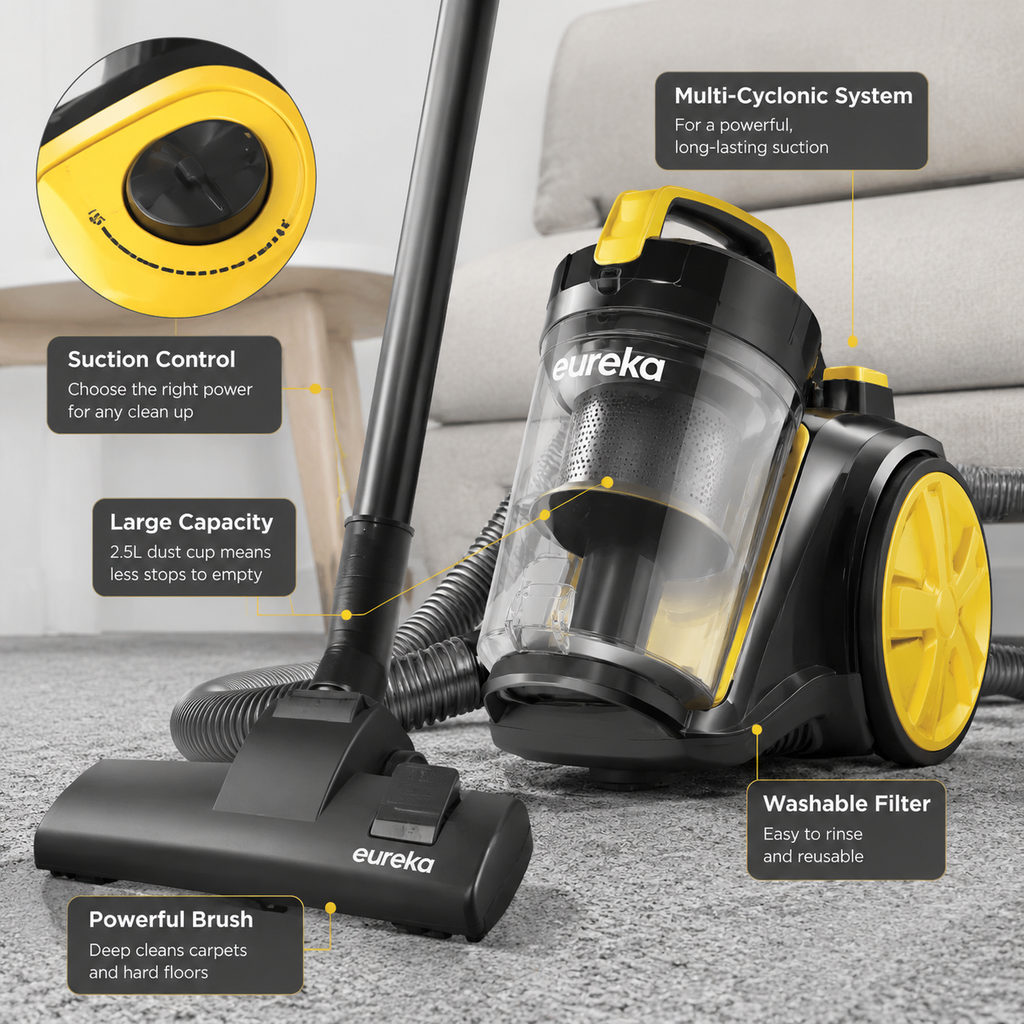
A small, light canister that covers carpet and hard floor with no tool swap in between, and it holds the strongest owner rating of the machines we compared. Five bags ship in the carton.
There's no motorized brush head and no HEPA claim in the listing, so deep plush pile is where it gives ground. The compact body also fills its bag sooner than bigger rivals.
Pros
- Lightweight for a canister, which makes stairs and multi-floor homes manageable
- Sealed triple HEPA system is a genuine benefit for allergy and asthma households
- 9.5-foot wand reach covers high and low spots most uprights can't touch
- Attachments store on the machine, so nothing goes missing in a closet
Cons
- Bagged design means an ongoing cost once the 2 included HEPA bags run out
- Only three attachments in the box, and there's no dedicated motorized pet brushroll
- Corded operation caps your working range at the 26-foot cord plus wand
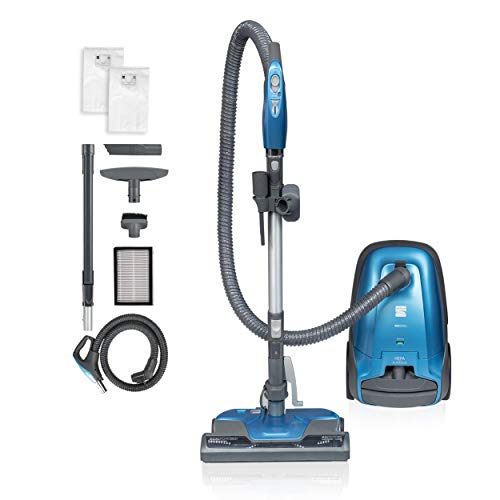
The premium seat, bought for hair volume rather than a spec sheet. Light for a full-size canister, manageable on a staircase, and the bags stay easy to source years into ownership.
The listing is thin, with no wattage or cord length anywhere in it. This is also the priciest pick by a clear margin, so a cat-only home won't see that money back.
Type: Corded bagged canister
Bag: Sealed, widely stocked
Feature: Pet tooling, lightweight body
Best use: Heavy-shedding dogs

Pros
- Serious suction numbers for a mid-priced canister, with variable power control to dial it back on rugs and drapes
- Sealed bagged system plus H13 HEPA is a better setup than most bagless models for allergy and asthma households
- About 9 ft of combined hose and wand reach covers a full staircase or a car interior from one spot
- Pet-specific turbo tool actually addresses hair tangling rather than just marketing around it
Cons
- Bags are a recurring cost, and you'll want to keep spares on hand since suction drops as the bag fills
- Corded operation ties you to outlets, so quick spot cleanups are slower than with a cordless stick
- A canister this powerful is bulky to haul upstairs and needs real closet space
The listing quotes 1600W and 40Kpa alongside an H13 HEPA filter, a 4QT bag and five tools, making this the most equipped machine of the five. The variable power control is the part you'll reach for daily.
Those suction numbers stay claims. At full power the head grips plush carpet hard, and the H13 filter is a consumable stacked on the bags.

Pros
- Genuine German Wessel attachments outperform generic floor tools
- Bagged design keeps dust contained during disposal, better for allergy sufferers
- 22-foot retractable cord eliminates tangling and storage hassle
- 1200W motor delivers consistent suction across all power settings
Cons
- No reviews yet to confirm long-term durability
- Replacement bags add ongoing cost compared to bagless models
- Best for low-pile carpets, may struggle with thick shag rugs
A 33ft cleaning radius plus a retractable cord means most rooms finish from one outlet. The Wessel turbo brush takes on cat and dog hair, and the wide parquet brush suits bare boards.
That turbo brush runs on airflow rather than a motor, so it slows in thick pile. Cord rewind mechanisms fail before anything else, and spares are less certain from a smaller brand.
Type: Corded bagged canister
Reach: 33ft cleaning radius, retractable cord
Feature: Wessel turbo brush + wide parquet brush
Best use: Long rooms with few outlets
Pros
- Compact and easy to store in small spaces
- Bagged system keeps dust contained during disposal
- Variable suction protects delicate surfaces
- Washable filters save money over time
Cons
- Bags add ongoing costs compared to bagless models
- 9-amp motor may struggle with deep carpet cleaning
- Limited attachments for specialized tasks
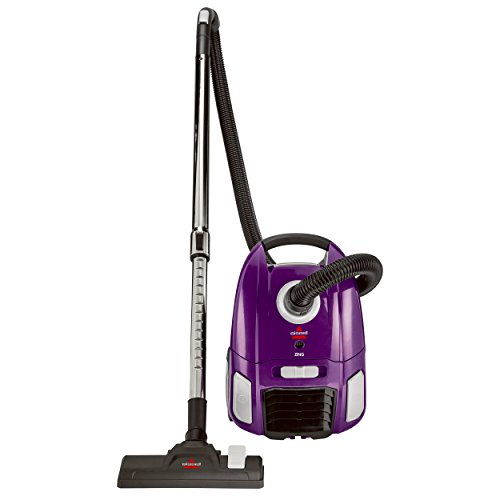
Tiny, light, and the cheapest route into a bagged canister from a brand whose bags sit on shelves everywhere. Built for a ten-minute pass rather than a whole-house session.
Lowest owner rating of the five. The small bag fills fast around pets, the body flips when you yank the hose past a doorway, and there's no powered brush head.
How We Picked These Canisters
Nobody here owned these machines. The ranking comes off published specifications plus a long read through owner feedback, with repeat complaints weighted heavier than the compliments. Hoses that split at the cuff after a year. Bags nobody stocks once the carton runs out. Wheels that scuff pale floorboards. Those recur across the category, and they’re what separates a canister you keep for a decade from one you resent by spring.
Order follows aggregate owner rating rather than personal preference, then we sorted by job. The comparison that matters most isn’t among these five, it’s between this shape and the one most people default to, so read our best upright vacuum picks alongside this page. An upright is one piece and it parks itself, and its powered brush roll digs at plush pile harder than any air-driven head does. A canister trades that away for reach, weight in your hand and quiet. Reach was the next filter. A stated cleaning radius past thirty feet changes how often you hunt for another outlet.
Best Canister Vacuum, Reviewed
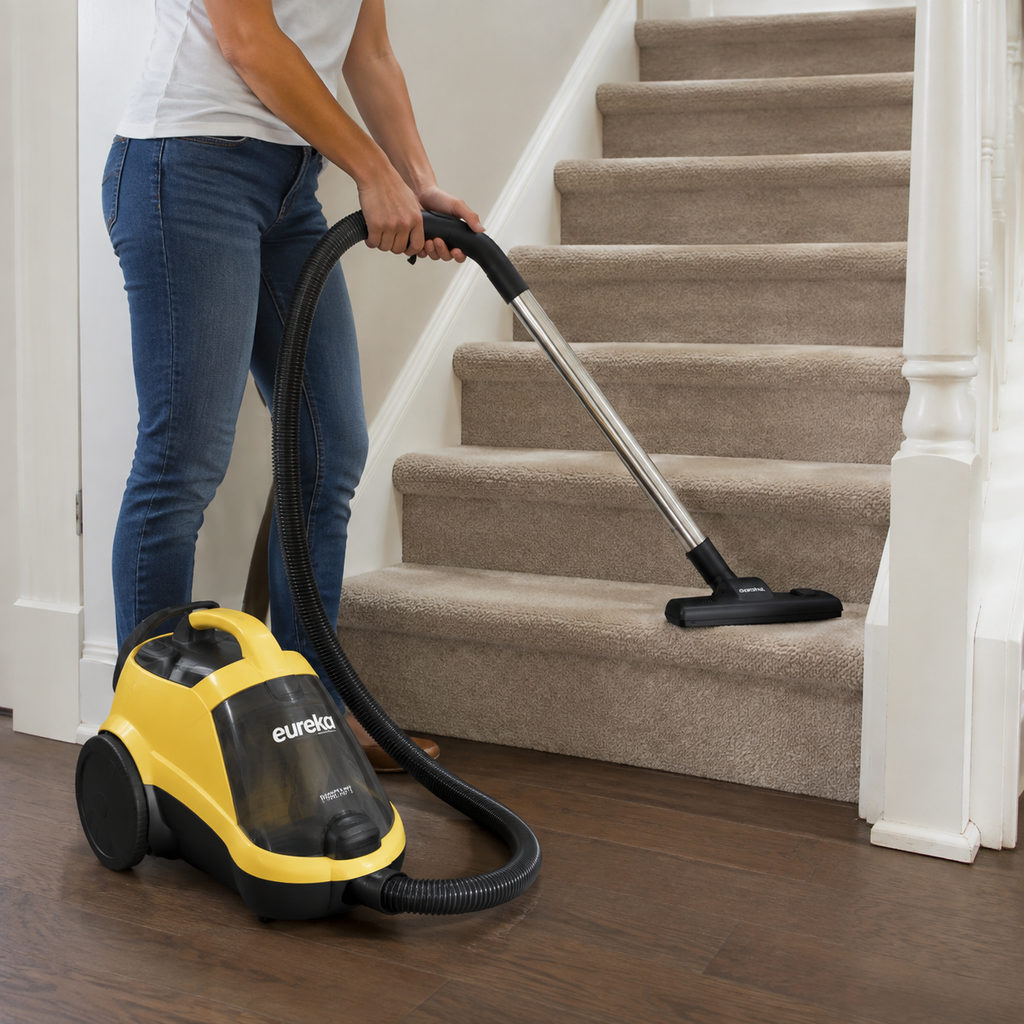
Eureka 3670M — Best Overall
This is the one we’d put in a first-time canister buyer’s cart. The 3670M is small and light enough to carry by the handle in one hand, and it does the two jobs most homes need: carpet and hard floor, no tool swap in between. Five bags ship in the box, which is Eureka being upfront that you’ll be buying more. Owner feedback sits at the top of this group, and the reason is boring reliability rather than any single feature. It pulls hard, and it keeps pulling. Where it gives ground is the spec sheet. There’s no motorized brush head here and no HEPA claim in the listing, both of which the Aspiron and the Akitas advertise. Deep plush pile is where you notice the missing brush, since suction alone lifts what sits on top but won’t agitate fibers. The body is compact as well, so the bag fills sooner than on the bigger machines below. Small machine, small appetite.
Kenmore Pet Friendly Canister — Best for Heavy Shedders
Kenmore’s pet canister takes the premium seat, and it earns most of that on reputation rather than a spec dump. The listing is unusually quiet: pet friendly and lightweight, then it stops. No wattage or cord length anywhere in it. What owners talk about is how much hair it swallows before the bag needs changing, and how manageable the body stays on a staircase for a full-size machine. That pairing is what a shedding-dog household actually needs. Kenmore has been building this shape longer than most brands on the list, and bag availability years into ownership is worth more than buyers expect on the day they order. The catch is the cost of entry. It’s the priciest pick by a clear margin, and you’re paying for pedigree and pet tooling instead of numbers you can line up against the Aspiron. Cat-only homes will get more out of spending less here.
Aspiron Canister 1600W — Most Capable on Mixed Floors
The Aspiron is the spec sheet of the group. Its listing quotes 1600W and 40Kpa, an H13 HEPA filter, a 4QT dust bag and five tools covering carpet, hardwood, stairs, pet hair and a car footwell. Read the suction figures as claims under ideal conditions, because that’s what they are, but the variable power control behind them is genuinely useful and rare at this level. Drop the power for a light rug that wants to climb into the nozzle. Wind it up for a hallway runner nobody has touched since March. The 4QT bag is the largest here, so fewer changes. Two honest problems. At full power the head grips plush carpet hard enough that you’re shoving rather than gliding, which turns the dial from a bonus into a necessity. And the H13 filter is a consumable stacked on top of the bags, giving this machine two things to reorder instead of one.
Akitas C11WT — Best Reach
Thirty-three feet of cleaning radius is the headline, and it changes the chore more than any suction figure does. Most rooms get finished from one outlet. The cord retracts at a button, which ends the closet-hook routine, and the kit pairs a Wessel turbo brush for cat and dog hair with a wide parquet brush for bare boards. For a house that’s half carpet, half hardwood, that’s the right two-head combination. HEPA filtration is claimed as well. Two things to weigh before ordering. The turbo brush is spun by airflow rather than a motor, so it slows when it meets thick pile, and hair still wraps around the bristles for you to cut free every few weeks. Retractable cord mechanisms are also the part that tends to fail first on any vacuum, and Akitas is a smaller name than Kenmore or Bissell, which makes bags and spares less certain in year four.
Bissell Zing 2154A — Lightest Grab-and-Go
The Zing is the machine you park in a hall cupboard for a ten-minute pass, not the one you plan a Saturday around. Tiny, light, and the cheapest route into a bagged canister from a brand whose bags sit on shelves everywhere, which counts for more than the gap in price suggests. Nothing here is clever. It picks up crumbs and pet hair off a rug, and that’s the brief. Owner rating is the lowest of these five, though, and the gripes are what a body this small implies: the bag fills quickly around pets, and the canister flips onto its side when you yank the hose around a doorway instead of following you politely. No powered brush head, no HEPA claim. For a studio, or a second machine kept upstairs so nobody hauls the good one between floors, it does the work. For a carpeted three-bedroom house, it doesn’t.
| Model | Type | Standout Spec | Best For | Price Tier |
|---|---|---|---|---|
| Eureka 3670M | Corded bagged canister | Light body, 5 bags included | Most homes, carpet and hard floor | Budget |
| Kenmore Pet Friendly Canister | Corded bagged canister | Pet tooling, easy bag sourcing | Heavy-shedding dogs | Premium |
| Aspiron Canister 1600W | Corded bagged canister | 4QT bag, H13 HEPA, power dial | Mixed floors & big cleans | Mid-range |
| Akitas C11WT | Corded bagged canister | 33ft radius, retractable cord | Long rooms, few outlets | Mid-range |
| Bissell Zing 2154A | Corded bagged canister | Smallest, lightest body | Apartments & quick passes | Budget |
Hose Reach, Bagged or Bagless, Noise
Hose plus wand is the number that decides whether stairs get easier. The whole staircase advantage here is that the body stays parked on the landing while you work down the treads. That only holds if hose and wand together reach the bottom step. A short hose means carrying the body down three stairs at a time, which is worse than an upright. Radius figures like the Akitas C11WT’s 33ft include the cord, so ask about hose length separately.
Bagged costs money forever, and it keeps the dust off your face. Every machine here is a bagged canister vacuum, still the norm for this shape, and not one of the five is bagless. You’ll reorder bags for as long as you own it, and that’s a running cost nobody should talk around. The payoff arrives at the trash can, where a sealed bag lifts out without the puff a bagless cup throws back at you. A bagless canister vacuum does exist if refills bother you, though the choice is thin and the well-regarded machines in this format almost all take bags, so read our best bagged vacuum picks before ruling them out. Homes where somebody reacts badly to household dust should weigh our best HEPA vacuum comparison too. Anyone with ongoing symptoms is better served by a doctor than a spec sheet.
The motor rides on the floor, which is why it can afford to be big. A powerful canister vacuum carries its motor in a towed body rather than in your fist, so it can hold a heavier motor and more insulation without becoming unwieldy to lift. That’s the structural advantage of the format, and it’s why a stick never quite matches it. The Aspiron Canister 1600W’s listing quotes 1600W and 40Kpa, read at the port under ideal conditions, so treat those as claims and not as what lands at your carpet. Airflow through the head is what lifts grit, so a stuffed bag or a grey filter costs you more pull than any wattage gap between two of these machines.
Quiet is a real feature, not spec-sheet garnish. A canister motor sits in a body on the floor with room around it for insulation, further from your head than an upright’s. That’s why the format has a reputation for being tolerable while somebody else is on a call next door. Nobody publishes honest decibel figures, so treat it as a tendency and not a promise.
It’s two pieces. Measure the closet before you order. An upright stands in a corner and takes one footprint. A canister is a body, a hose, a wand and a nozzle head, and the hose is the part that refuses to coil neatly. Storage turns into regret more often than suction does. Check for onboard clips to hold the wand, because machines without them end up scattered across the cupboard floor.
Frequently Asked Questions
Is a canister vacuum better than an upright?
Different, not better. An upright is one piece with a motorized brush roll, and it wins on deep plush carpet. A canister wins on stairs and under low furniture, and it’s usually the quieter machine, since what you hold is only a wand. Houses with a lot of hard floor and a staircase are where the canister case gets strong.
Do canister vacuums work on carpet?
On low and medium pile, yes. Deep plush is the weak spot, since most canister heads either carry no brush or use an air-driven turbo brush that slows in thick fibers. The Aspiron Canister 1600W copes best of these thanks to its power control. If nearly every room is plush, buy an upright.
How often does the bag need replacing?
Roughly monthly for a household vacuuming weekly, sooner with a shedding dog or a small body like the Bissell Zing 2154A’s. Larger bags stretch the interval, which is why the Aspiron’s 4QT capacity earns its place. Don’t push a bag past full, because a packed bag chokes airflow long before the motor is at fault.
Is there such a thing as a bagless canister vacuum?
A few brands sell one, but the format stayed with bags while uprights went the other way, and none of these five is bagless. What you save on refills you pay back at the bin, emptying a cup at arm’s length and rinsing a filter stack. Choose bagless to stop reordering, bagged for the cleaner hand-off.
How much suction does a powerful canister vacuum need?
Enough airflow at the head, which isn’t the same as the biggest number on the carton. The Aspiron’s listing quotes 1600W and 40Kpa, though a full bag or a clogged filter robs more pull than the gap between it and the Eureka 3670M. Bare floors and low pile leave any of these five with suction to spare. Plush carpet wants agitation, and that’s a brush problem rather than a power one.
Are canister vacuums good for pet hair?
They can be, with the right head on the wand. Suction alone leaves hair woven into carpet, so look for a turbo or pet brush in the box, as the Kenmore Pet Friendly Canister and the Akitas C11WT both include. You’ll still cut wrapped hair off the bristles every few weeks. That’s the job, on any vacuum.
Related Guides
- best lightweight vacuum
- best cordless vacuum for hardwood floors
- best robot vacuum without mop
- More vacuum & floor care guides
The Bottom Line
Canisters aren’t fashionable and they aren’t tidy, and for a home with stairs, bare floors and furniture worth reaching under, they make more sense than the market’s attention suggests. Start with the Eureka 3670M. It’s the cheapest of the group, it holds the strongest owner rating, and the five bags in the carton carry you through the first months. Move up to the Aspiron Canister 1600W if you want the 4QT bag plus a power dial the others don’t offer, which makes it the most adaptable pick for mixed floors. A household with a heavy shedder should look at the Kenmore Pet Friendly Canister, where the tooling and long-term bag supply justify the premium. Long rooms with one outlet? The Akitas C11WT’s 33ft radius saves the trips. Buy for your hardest room rather than your easiest, and accept that something follows you around.

Leave a Reply