

Eight hours in a seat that is already moving under you is a different job from a forty-minute commute. Air-ride suspension floats the whole seat on a bag of compressed air, so the foam beneath you gets loaded and unloaded thousands of times a shift, which is why the best seat cushion for truck drivers has to survive something a commuter pad never faces. Cheap foam packs down. Not over years, either: drivers logging nine or ten hours a day, five and six days a week, report a soft cushion going flat and hard under the sit bones inside about three months. Density and recovery matter more here than how plush the thing feels the day it arrives.
Our five picks split by configuration rather than by brand. GKTKG and MATIisEYE both ship as a set with a matching headrest. StarAneer is a single L-shaped piece that runs up the seatback in one continuous curve. japiroc is a plain X-Large pad for a wide pan, and Elmara pairs its seat cushion with a full back panel. What sorts them out after that is unglamorous. Whether the base creeps forward on vinyl while the suspension cycles. Whether the cover unzips for a laundromat wash, and whether the foam still has any spring left by the time your next DOT physical rolls around.

Pros
- Two-piece design covers seat and neck support together rather than one or the other
- Gel-infused foam addresses heat buildup, a common complaint with plain memory foam cushions
- Non-slip rubberized base is specifically built for the vinyl and cloth seats found in trucks
- Removable cover is machine washable, easy to keep clean between routes
Cons
- Explicitly designed for average to smaller builds, so larger drivers will likely find the cushion too narrow
- No buyer feedback available yet, so long-term foam durability is unproven
- Headrest fit depends on your seat's shape and adjustment range, and it won't work equally well in every cab
Two matched pieces, a seat cushion plus a headrest pad, both sized for a wide air-ride pan rather than a car seat. The headrest is the part that surprises people on a long afternoon, since it cuts down the small corrections your neck keeps making.
It's firm out of the box and wants about a week of shifts to settle in. Two pieces also means two things to reposition every time you climb back up.

Pros
- Combined lumbar and coccyx support in one cushion instead of two separate pads
- Firm high-density foam aimed at all-day use rather than short desk sessions
- Ventilated hollow-core design targets the sweaty-back problem directly
- Dual-lock system with rubber base and long adjustable straps for seats that move
- Works across truck seats, office chairs, and wheelchairs
Cons
- Firm, supportive foam won't suit anyone who prefers a plush, sink-in feel
- The L-shape raises and pushes you forward, which can throw off mirror and pedal position until you readjust
- Product listing is new with almost no buyer feedback, so long-term durability claims aren't verified yet
One continuous L-shaped panel running from under the sit bones up through the lumbar curve, so nothing slides down behind the seat between stops. Cool-mesh cover, memory foam, plus a cutout at the rear edge.
Fit is the risk here. On a seat with strong side bolsters or an air lumbar already pumped up, the vertical section stands off the back and nudges your shoulders forward. Let the lumbar down first.

Pros
- Sized for truck seats rather than compact car seats, so you get real thigh support
- Sealed inner cover protects the foam from sweat and grit over high mileage
- Breathable, zippered outer cover comes off easily for cleaning
- Wedge shape targets coccyx pressure, a common complaint for drivers who sit six-plus hours
Cons
- The 4.33" rear lift changes your seating height, so you'll likely need to reset mirrors and steering position
- That 16.14" width won't tuck in cleanly on a narrower bench or bucket seat
- The 'vibration control technology' claim isn't backed by any published specs, so treat it as marketing
An X-Large flat pad with more surface than a car cushion offers, which keeps your thighs on foam instead of half on bare upholstery across a broad seat pan. No straps, no back panel, nothing to route.
The foam sits on the softer side of medium, and that's what leaves a permanent dent under the sit bones after a season of daily use. Rotate it end for end. Nothing here supports the lumbar curve.
Pros
- Complete lower-body and lumbar coverage from a single purchase
- Non-slip base and straps keep it in place without fiddling
- Cut for semi-truck seat dimensions rather than generic office chairs
- 2-year warranty signals confidence in the foam holding its shape
Cons
- Elmara recommends about a week of use before your body adjusts, so relief isn't instant
- At 20 by 17 inches, the base is built for semi seats and may overhang smaller car seats
- Adding a cushion raises your seating position, which can change your reach to the wheel and pedals
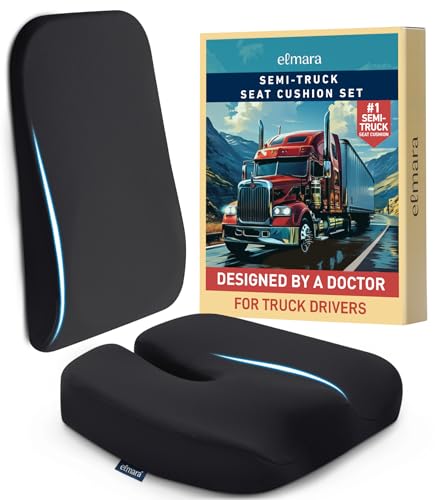
The only pick pairing a seat cushion with a full back panel instead of a headrest, both halves matched in firmness so they don't go lumpy where the two meet. Suits a driver who slouches by mid-afternoon.
The back piece needs a strap route, and wraparound armrests can leave nowhere clean to anchor it. Owners say the black cover is slow to dry fully as well. Priciest of the group.

Pros
- Two-piece set addresses both seat and neck comfort in one package
- Coccyx relief cut-out targets a common pain point for drivers
- Adjustable straps help stabilize cushions on different seat types
- Memory foam construction offers durable, responsive support
Cons
- Zero customer reviews yet, so real-world performance isn't verified
- Memory foam may retain heat during summer driving
- Cushion thickness could reduce headroom in compact truck cabs
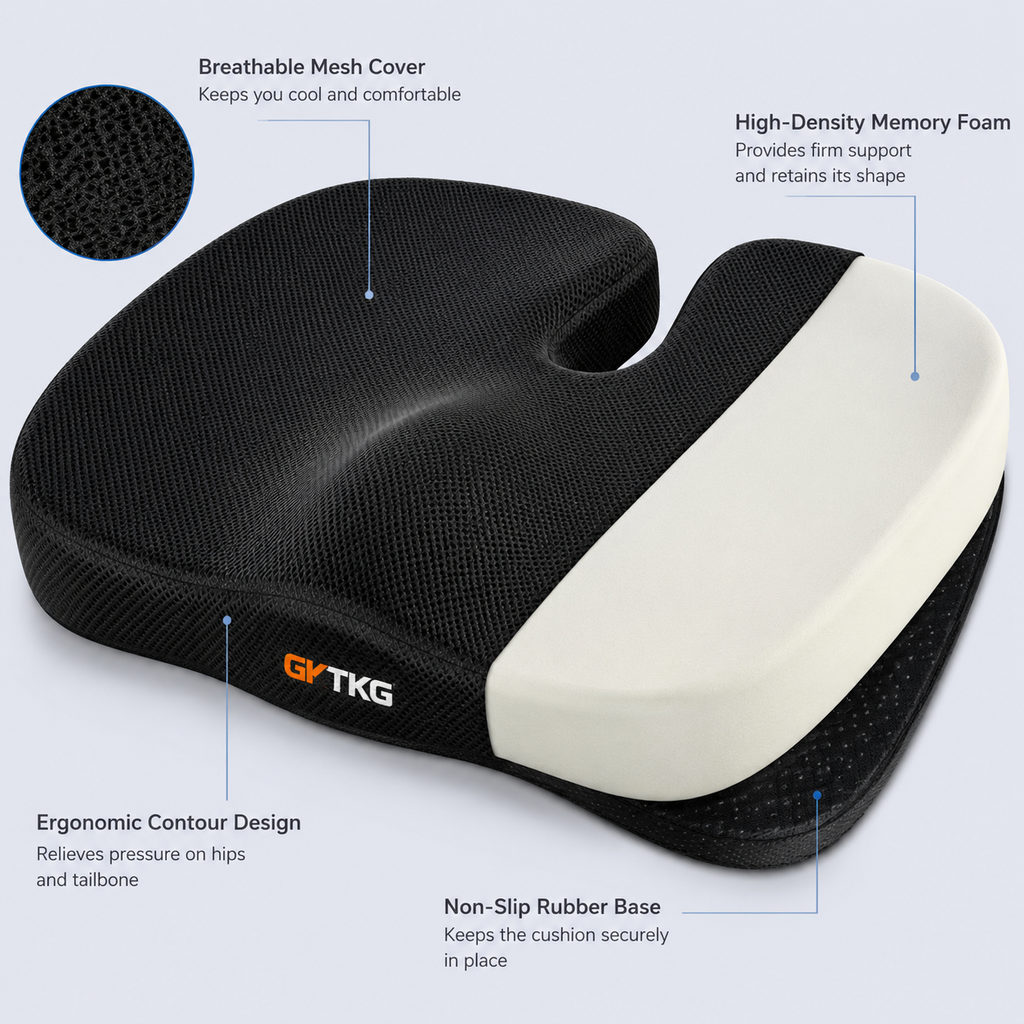
Same arrangement as the GKTKG at a lower price: a memory foam seat cushion plus a headrest cushion aimed at long haul drivers. A cheap way to work out whether a headrest pad does anything for you.
Thinner foam through the middle, so heavier drivers reach the pan sooner. The base doesn't hold on vinyl either and walks forward as the suspension cycles. A rubber liner underneath fixes that.
How We Picked for Long-Haul Seats
Nobody at this site drives a rig for a living, and none of these cushions crossed Nebraska with us. What we did was compare stated foam type and thickness, base shape, cover material, and whether the piece comes apart for cleaning, then read owner feedback for the complaints that only surface after a few thousand miles. Those complaints repeat across the category. Foam bottoming out under the sit bones by month three. Covers that photograph like woven fabric and turn out to be a laminate holding sweat against the back of your legs. Straps routed right where a suspension seat flexes, working loose with every climb down.
Ratings decided the order. We didn’t push a personal favorite past a better-rated product, because the badge on each card is computed from the Amazon rating and would simply argue with the prose. One distinction worth making early: a class 8 seat is not a car seat. It has suspension travel of its own, a wider pan, air lumbar in a lot of cases, and armrests that limit how far a back panel can stand off the seatback. If the vehicle in question is a pickup you drive to a job site instead of a sleeper cab, the shapes in our roundup of the best car seat cushion options fit those bucket seats better.
Best Seat Cushion for Truck Drivers, Reviewed
GKTKG 2-in-1 Set — Best Overall for Full-Time Drivers
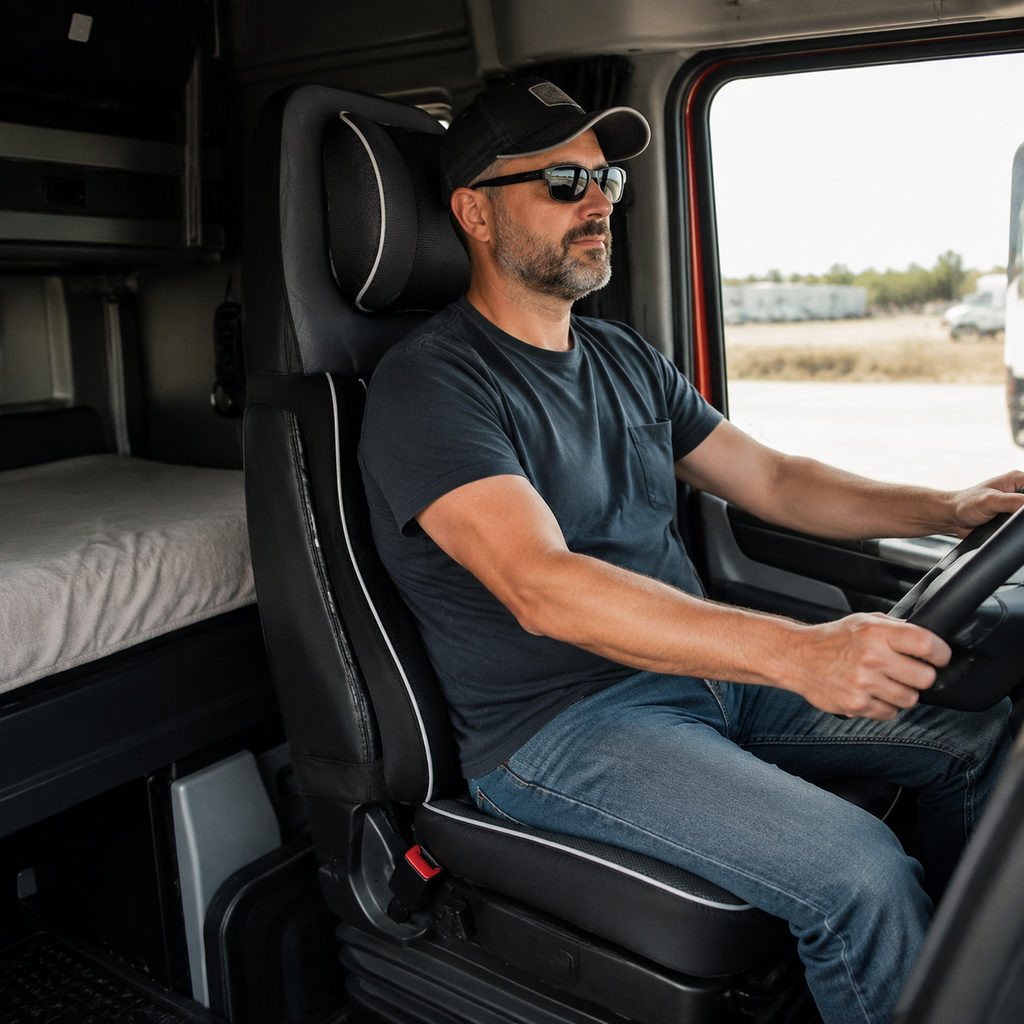
GKTKG holds the highest owner rating of the five, and the 2-in-1 framing is honest enough. You get a seat cushion and a headrest cushion sized to work with each other, instead of a seat pad from one brand and a neck roll from another. The headrest is the piece people underestimate. Your head is what keeps drifting on a long afternoon, and a pad that fills the gap between a flat factory headrest and the back of your skull cuts down the small corrections your neck makes for hours. The seat piece is still the reason to buy it, sitting square on a wide pan without riding up over the bolsters. The trade-off is the two-piece format itself: two things to strap and two things to reposition after every climb down. The headrest is the one that ends up loose on the bunk. Owner feedback also flags it as firm out of the box, wanting a week of shifts to settle.
StarAneer L-Shaped Cushion — Best One-Piece L-Shape
One piece rather than two, which for plenty of drivers settles the argument on its own. The StarAneer runs from under the sit bones up through the lumbar curve as a single continuous panel, so there is nothing to realign after a fuel stop and nothing that slides down behind the seat overnight. Its listing calls the surface a breathable cool-mesh pad, and mesh is the right call in a cab with a windshield the size of a patio door. Memory foam through both legs of the L, with a cutout at the rear edge under the tailbone. Cheapest of the five as well. Fit is where it can go wrong: an L-shaped panel assumes your seatback curves roughly the way the cushion does, so on a seat with strong side bolsters or an air lumbar bladder already pumped up, the vertical section stands off the back and nudges your shoulders forward. Let the air lumbar down first, then judge it.
japiroc X-Large Pad — Best for Wide Air-Ride Pans
Seat width is what japiroc is selling. X-Large in the title means more surface than a typical car cushion offers, and that matters on a broad air-ride pan where a small pad leaves your thighs half on foam and half on bare upholstery. That seam is exactly where a ridge shows up around hour four. No headrest, no back panel, no strap to route around a suspension mechanism. Memory foam and a cover, and the simplest thing here to live with. Simple also means limited. Nothing on this one supports the lumbar curve, so if what bothers you sits above the belt line rather than underneath you, it is the wrong shape. Owner feedback puts the foam on the softer side of medium, which reads as comfortable on day one and is exactly what produces a permanent dent under the sit bones after a season. Rotate it end for end every few weeks and you’ll get more life out of it.
Elmara 2-Piece Set — Best Seat and Back Combination
Priciest of this group, and the only pick that pairs a seat cushion with a full back support panel instead of a headrest. That combination suits a driver who slides into a slouch as the day wears on, since the back piece fills the hollow above the waistband and makes slumping take actual effort. Both halves are matched in firmness, which sounds like a trivial detail and is not: mismatched foam is why so many aftermarket seat-and-back pairs feel lumpy right where the two meet. The listing leans on doctor-designed language, and we read that as copywriting rather than a spec, so weigh the set on its geometry and foam density. Two real limits. The back panel needs an anchor point, and a seat with wraparound armrests may not leave a clean route for the strap, so check yours before ordering. The black cover is also slow to dry fully after a July shift, per owners, a nuisance if you wash it between runs.
MATIisEYE Headrest Set — Lowest-Commitment Headrest Set
Cheaper of the two headrest sets, and that is the case for it. MATIisEYE gives you the same basic arrangement as the GKTKG, a memory foam seat cushion plus a headrest cushion aimed at long haul drivers, for less money. For someone curious whether a headrest pad does anything for them, it is a sensible way in. It also carries the lowest owner rating on this page, and the reasons are consistent across reviews. The foam runs thinner through the middle than the japiroc’s, so a heavier driver reaches the seat pan sooner than they would like. Base grip is the other recurring gripe. On smooth vinyl the seat piece walks forward as the suspension cycles, and by the end of a shift there is an inch of gap behind it. An elastic strap or a rubber shelf liner underneath solves most of that for almost nothing. Decent value, shorter life.
| Model | Configuration | Foam and Cover | Best For | Price Tier |
|---|---|---|---|---|
| GKTKG 2-in-1 Set | Seat cushion plus matching headrest | Firm foam, settles after a week | Full-time drivers who want both pieces matched | Mid-range |
| StarAneer L-Shaped Cushion | One-piece L, seat and back joined | Memory foam, cool-mesh cover | One thing to fit and forget | Budget |
| japiroc X-Large Pad | Flat X-Large seat pad only | Softer memory foam, plain cover | Wide air-ride pans, no straps | Budget |
| Elmara 2-Piece Set | Seat cushion plus full back panel | Matched firmness, black cover | Slumping as much as aching | Premium |
| MATIisEYE Headrest Set | Seat cushion plus headrest | Thinner foam, weak base grip | Sampling the two-piece format | Mid-range |
Air-Ride Seats, Shift Work and Foam That Lasts
An air-ride seat moves all day, and a cushion without grip moves with it. Suspension travel means the pan is rising and dropping under you for the whole shift, and that works a smooth-bottomed cushion forward an inch at a time until the back edge is sitting proud of the seat. Look for a rubberized or silicone-dotted underside, or an elastic loop that goes around the cushion itself. Cloth upholstery holds a pad far better than vinyl, so this matters most in a truck with a wipe-clean seat.
Foam density beats foam softness once you are past hour two. A soft cushion feels better for the first hour and worse for the next nine, because your sit bones sink through it and end up loading the seat pan the way they did before you bought anything. High-density memory foam feels stiffer at first and keeps its shape through the day. Rotating it end for end every few weeks spreads out the compression.
The second piece solves one problem and hands you another. A headrest pad or back panel does something a seat cushion physically cannot, filling a gap your neck or lumbar curve has been bridging with muscle. It also means a second thing to strap, a second thing to knock loose swinging out of the cab, and a second cover in the wash. A one-piece L-shape sidesteps all of that, at the cost of adjustability, since you can’t slide the back section to where your own curve sits. Anyone shopping around nerve pain down one leg should look at the cutout geometry in our guide to the best seat cushion for sciatica, a different buying problem from this one.
Covers get washed far more often in a cab than at a desk. Sweat, coffee, diesel on your jeans. A cover that unzips and survives a laundromat cycle is worth more over a year than slightly nicer foam, because the alternative is scrubbing a whole cushion in a truck stop bathroom. Mesh and woven panels move air; laminated covers that photograph like leather hold heat against your legs from the first mile. Check that the zip runs most of the length, since a short zip turns getting a damp cover back onto dense foam into a wrestling match.
Frequently Asked Questions
How long does a truck seat cushion last on a full-time schedule?
Reckon on a year or two from high-density memory foam under a driver logging nine or ten hours a day, and a few months from soft budget foam. The tell is a dent under the sit bones that hasn’t recovered by morning. Rotating the cushion end for end and letting it air out on your days off both stretch that out.
Does a cushion interfere with the air suspension?
No, the suspension sits under the seat rather than in the cushion, so nothing you put on top changes how it works. What does change is your height above the pan and how your weight loads it. Re-check your mirrors and your reach to the pedals after the first shift, and drop the seat height a notch if the cushion added much more than an inch.
Is an L-shaped cushion better than a separate seat pad and back cushion?
Depends on your seat. An L-shape stays put and gives you a single thing to fit, which is why a lot of drivers prefer it. A separate back piece can be raised or lowered to match where your lumbar curve actually falls, and that adjustability wins on a seat with an air lumbar bladder or an unusual backrest rake.
Do these do anything for back pain from driving?
What a cushion changes is physical. Firmer support under the sit bones keeps your hips from sinking into a seat whose foam has collapsed, and a back panel alters the angle your spine holds while you drive. Owners on long runs report both make a shift easier to sit through, and others report no difference at all. Pain that persists no matter what you sit on is a question for a doctor, not for a cushion.
Related Guides
- best cooling mattress topper
- best firm mattress topper
- best mattress topper for hip pain
- More sleep & comfort guides
The Bottom Line
For most drivers running a full week, the GKTKG 2-in-1 Set is where we’d start. Highest owner rating of the five, a seat piece sized for a wide pan, plus a headrest cushion that earns its keep on the long afternoon stretch. Want one thing to fit and then forget? The StarAneer L-Shaped Cushion is the cheapest here and the least fussy, assuming your seatback curve agrees with it. Drivers on a very broad pan who want nothing strapped to the seatback should take the japiroc X-Large Pad, while anyone slumping as much as aching will get more out of the Elmara 2-Piece Set and its full back panel. The MATIisEYE Headrest Set is the low-stakes way into the two-piece format, with thinner foam to match the lower price. Whichever turns up, give it a week of real shifts before judging. Dense foam feels wrong on day one and right by day seven.

Write Your Review
No reviews yet. Be the first to share your experience!